
Learning Ukulele with Curt
HZ - Frequencies
If you always wanted to know what Hz meant and how I could use it to tweak my sound. Knowing the frequencies, the HZ of the notes of the ukulele can help you to know what to cut or boost when it comes to sound.
Publisher: Curt Sheller Publications
Authors(s):
Curt Sheller
Category: Reference
Instrument: Any
Subjects(s): Audio • Hz
Subjects(s): Audio • Hz
Premium Member Feature
Premium Member Feature
Premium Member Feature

1 March 2026
All 1 sample page(s) are viewable on-line.
If you're a registered site member, have verified your email address, and have the correct permissions you can view ALL the pages of this PDF or Samples pages at a larger size using the LearningUkulele.com Online PDF Viewer.
Downloads only available to register site members
This Download is NOT part of your LearningUkulele.com / Learning Ukulele with Curt membership level.
Sign-up for Premium Site Access or Upgrade Your Plan your current access level to download this PDF or your can purchase a copy for download.
Register for Access …
After purchasing a PDF
a download link or PDF will be sent to you within 48hrs.
Contact LearningUkulele.com / Learning Ukulele with Curt if there are any issues.
Each PDF file is a professionally formatted, high resolution file that prints out great. You'll need a PDF Reader or application capable of viewing PDF files to view the PDF. Most likely standard and already installed on your computer or mobile device.
NOTE: Download the current PDF file for the latest, complete, and most up-to-date version. As well as additional information not presented on-line.
Members and Active Students need to sign-in to download this lesson's PDF for the complete lesson.
HZ - Frequencies
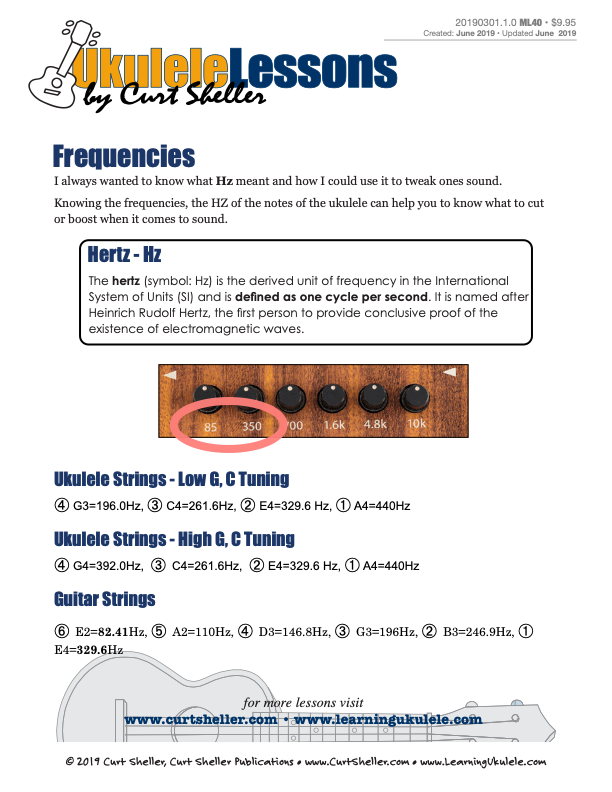
If you always wanted to know what Hz meant and how I could use it to tweak my sound.
Knowing the frequencies, the HZ of the notes of the ukulele can help you to know what to cut or boost when it comes to sound and setting on your effects pedals.
Hertz—Hz
The hertz (symbol: Hz) is the derived unit of frequency in the International System of Units (SI) and is defined as one cycle per second. It is named after Heinrich Rudolf Hertz, the first person to provide conclusive proof of the existence of electromagnetic waves.
MIDI note number shown with each frequency: Middle C is C4.

MIDI Note/Key Number Chart Frequency Chart (Pitch to Note) . The lowest note on a standard 88 key piano is A0 (21.5Hz). Below that we are in elephant hearing land. Humans with very good hearing can just barely detect sounds at 20 Hz, but part of a typical elephant rumble is below 20 Hz, so humans can’t hear that.
Standard Ukulele and Guitar Tunings
These are what have been , historically called the
Standardtunings for ukulele and guitar.
Ukulele • Low G, C Tuning
- G3 = 196.0 Hz
- C4 = 261.6 Hz
- E4 = 329.6 Hz
- A4 = 440 Hz
Ukulele • High G, C Tuning
- G4 = 392.0 Hz
- C4 = 261.6 Hz
- E4 = 329.6 Hz
- A4 = 440 Hz
If you always wanted to know what Hz meant and how I could use it to tweak my sound.
Knowing the frequencies, the HZ of the notes of the ukulele can help you to know what to cut or boost when it comes to sound and setting on your effects pedals.
Hertz—Hz
The hertz (symbol: Hz) is the derived unit of frequency in the International System of Units (SI) and is defined as one cycle per second. It is named after Heinrich Rudolf Hertz, the first person to provide conclusive proof of the existence of electromagnetic waves.
MIDI note number shown with each frequency: Middle C is C4.
MIDI Note/Key Number Chart Frequency Chart (Pitch to Note) . The lowest note on a standard 88 key piano is A0 (21.5Hz). Below that we are in elephant hearing land. Humans with very good hearing can just barely detect sounds at 20 Hz, but part of a typical elephant rumble is below 20 Hz, so humans can’t hear that.
Standard Ukulele and Guitar Tunings
These are what have been , historically called the
Standardtunings for ukulele and guitar.
Ukulele • Low G, C Tuning
- G3 = 196.0 Hz
- C4 = 261.6 Hz
- E4 = 329.6 Hz
- A4 = 440 Hz
Ukulele • High G, C Tuning
- G4 = 392.0 Hz
- C4 = 261.6 Hz
- E4 = 329.6 Hz
- A4 = 440 Hz
Sign-IN, for free — to View, Un-Blur Any Additional Content for This Lesson—Can't give it ALL away.
more
HZ - Frequencies
Bass Guitar
Standard Tuning
- E1 = 41.20 Hz
- A2 = 55 Hz
- D1 = 73.42 Hz
- G2 = 98 Hz
Guitar
Standard Tuning
- E1 = 82.41 Hz
- A2 = 110 Hz
- D1 = 146.8 Hz
- G2 = 196 Hz
- G2 = 246.9 Hz
- G2 = 329.6 Hz
Download the PDF file for the latest, complete, and most up-to-date version. As well as additional information not presented on-line.


End of Lesson - Thanks, Hope You Enjoyed It!
Related Lessons, Videos, Lesson Series, Songs, Books & Reference Charts, Resources & Assets, Workshops are below.