


 A Roadmap Through a Song • Your roadmap through a song includes – the landmarks, traffic signs and directions to and from one place to another place, the beginning of the song, to another parts of a song, the end of the song.
For a song this roadmap includes the key, any modulations to other tonal centers, the sections, type of chords, codas, repeats and the music signs used to determine your path through the song. Basically, the form the song is to take when performing the song.
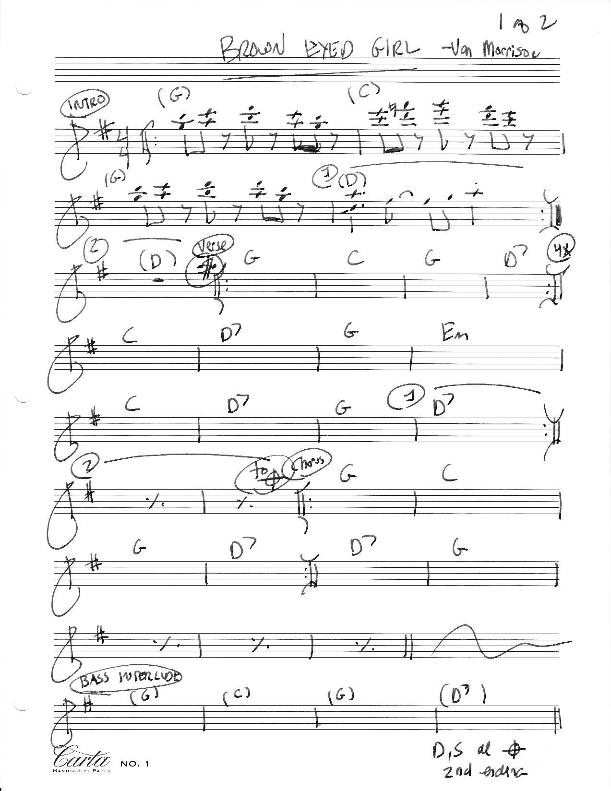
A Chord Chart is simply these directions. It contains the chords and form of the song to play. I might or might not contain directions on where to put your fingers, chord diagrams or where to play any particular note. Depending on the intended final use of the chart, it simply the chords to a completely written out instrument part for a recording.
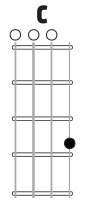
At a minimum, it should contain are the chords and form of the song. The lyrics are for the singers. Chord diagrams are for beginners who might not have a chord vocabulary of chords to cover all the chords in a given song. TAB serves a different function and is not needed in a chord chart.
Depending on the song, my chord charts might contain any signature licks and riffs for that song. These will be in standard notation on the chart. I'll provide a TAB for ukulele players separately. Using standard music notation allows ANY musician that can read music to play the song on any instrument.
NOTE: Actually know the song "Intellectually', the chords, the key, the starting melodic intervals go a long, long way in helping you remember songs.
Reading can be thought of on many different levels. 1) the ability to slowly and painfully work out the written music. 2) the ability to hear the music by looking at the notation. 3) the ability to notate your ideas in standard music notation. 4) the ability to read music as you read a book or an article. 5) the ability to communicate with other musicians in the written language of music. 6) the ability to learn songs that you have never heard.
In the realm of music, there are certain aspects that students and players often tend to avoid. These include skills such as learning to read music and familiarizing themselves with the notes on their instrument. While these tasks may seem challenging, particularly on the fretted string instruments, they are comparatively easier on the ukulele. With the appropriate guidance and a well-defined plan, mastering these skills can be a smooth and achievable process.