


Ukulele Tunings
Common Ukulele Tunings
Any tuning is possible on a ukulele as long as the ukulele's construction supports it and a string is available.
Tune UP That `Ukulele
Yes! Tune Your Ukulele
Yep! — You actually have to tune the uke. Remember you are always training your ear and want to ensure that your are sending and receiving quality musical information.
Although your ukulele was tuned at the factory or by your custom builder. It, most likely needs it again and needs to be checked often.
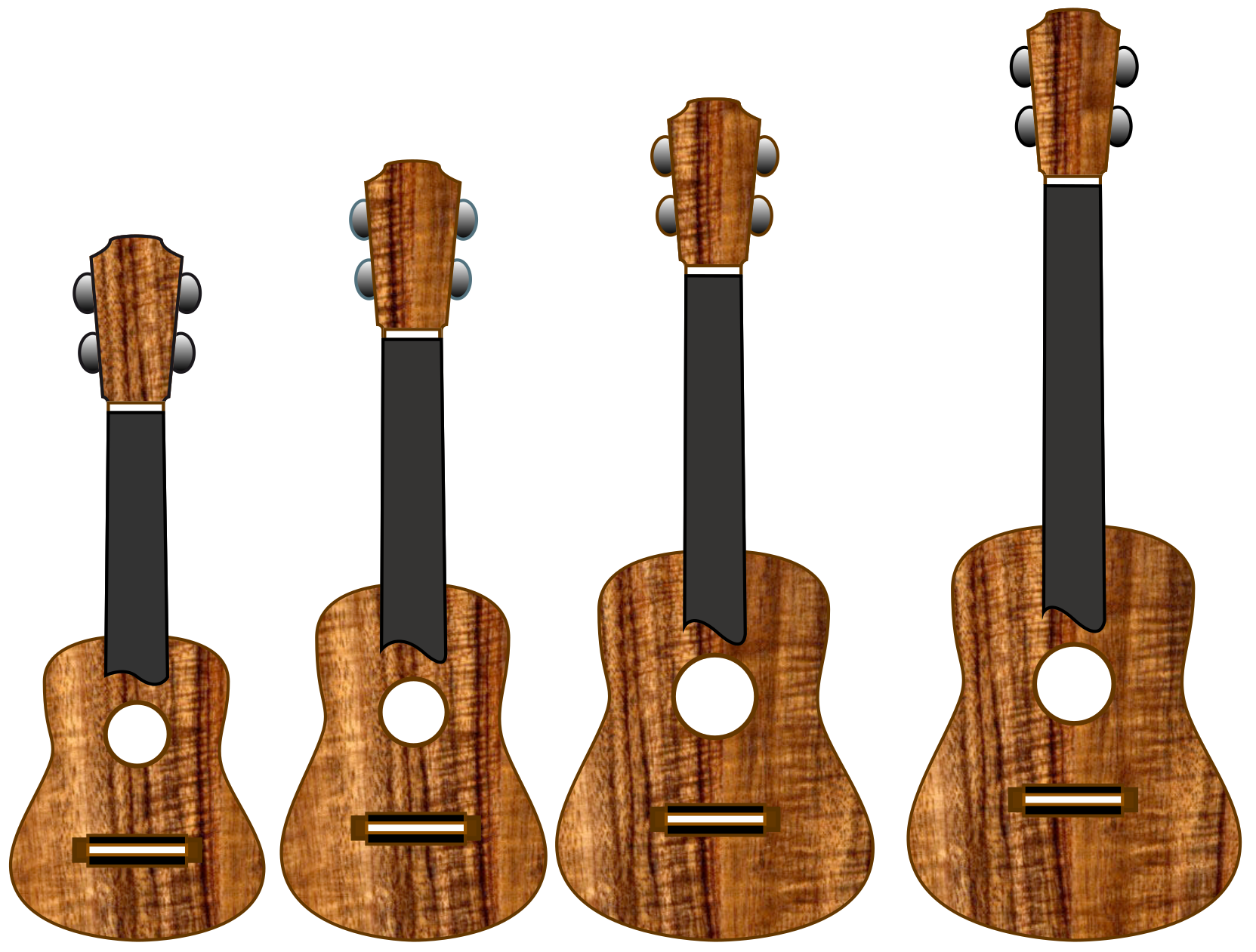
four ukes
What Tuning?

ANY tuning is possible on a ukulele as long as the ukulele's construction supports the required string tension and a string is available . The manufacture or the builder of the ukulele would or should have this string tension information. The string manufacture typically has the tension information for their strings on their respective web sites.

There are three common tunings in popular use today, C, D and G tuning — with C tuning being the most popular.

Re-entrant Ukulele Tuning?

If coming from the guitar world where the strings, tuned low to high, is often called a linear tuning. An instrument like the ukulele with a higher pitched string four is called a re-entrant tuning where the lowest note of the instrument might not be the lowest string. This can seem a little strange at first. The re-entrant tuning, places all the notes of a chord within one octave, is part of the unique ukulele sound. This tuning is especially common for the smaller soprano and concert ukuleles.

Tuning is one of the aspects of the ukulele that gives it its charm. Or, it's a plot by builders and manufacture to have you buy more ukuleles.

Here is a great article on tuning systems by Richard Sleigh.
Check out Richard Sleigh's • War of the Musical Worlds! (Equal Temperament vs. Just Intonation) about these two tunings. This is the best explanation I've read on the difference and why you might want one vs. the other.
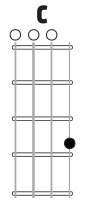
C Tuning • Hawai'ian Tuning
C Tuning is the most common tuning used today.
C Tuning, High 'G'

C Tuning - For Soprano, Concert and Tenor ukulele. The same as the higher four strings of a standard tuned guitar with a capo at the fifth fret with string four "G" one octave higher.
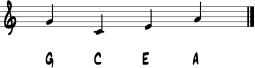
For setting up music notation programs like Finale and Sibelius this tuning is:
MIDI: G = G3, C = C4, E = E4, A = A4
C4 is middle C.

For tweaking EQ in performance situations:
Frequency: G4 = 392.0 Hz, C4 = 261.6 Hz, E4 = 329.6 Hz, A4 = 440.0 Hz
C4 is middle C.

C Tuning, Low 'G'

Low 'G', C Tuning - For Soprano, Concert and Tenor ukulele. Same as Key of "C" Tuning but with string four one octave lower. This is the same as placing a capo at the fifth fret of a standard tuned guitar.
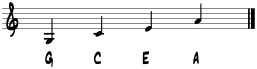
For setting up music notation programs like Finale and Sibelius this tuning is:
MIDI: G = G3, C = C4, E = E4, A = A4
C4 is middle C.

For tweaking EQ in performance situations:
Frequency: G4 = 196.0 Hz, The rest is the same as the High "G" - C Tuning, C4 = 261.6 Hz, E4 = 329.6 Hz, A4 = 440.0 Hz
C4 is middle C.

G Tuning • Baritone / Guitar Tuning
G Tuning is common on the Baritone ukulele and can also be used on a tenor ukulele with a high D string four.

Key of "G" Tuning - For Baritone and Tenor ukulele. The same as the higher four strings of a standard tuned guitar. So you already know how to play the Baritone and Tenor Ukulele.
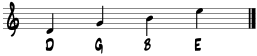
For setting up music notation programs like Finale and Sibelius this tuning is:
MIDI: D = D3, G = G4, B = B4, E = E5
C4 is middle C.
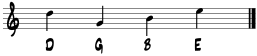
String 4 can also be tuned up one octave. A tuning that the late great jazz ukulele player Lyle Ritz favored.
For setting up music notation programs like Finale and Sibelius this tuning is:
MIDI: D = D4, G = G4, B = B4, E = E5
C4 is middle C.
Different Ways to Tune a Baritone
Here is a cool video by Aaron Kiem about the various way to tune a baritone ukulele.
The tunings Aaron goes over are: D G B E, G C E A ("Low G), d G B E ("High" D), d G B D (Banjo Tuning)
D Tuning • European Tuning
D Tuning is a popular tuning in Canada, Europe and was popular is the previous two waves of ukulele popularity.
D Tuning allows you to use open position chords in the common guitar, bluegrass, country, rock, folk keys of D G, and A.
D Tuning, High 'A'
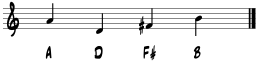
"D" Tuning - For Soprano, Concert and Tenor ukulele. The same as the higher four strings of a standard tuned guitar with a capo at the seventh fret with string four "A" one octave higher.
For setting up music notation programs like Finale and Sibelius this tuning is:
MIDI: A = A3, D = D4, F# = F#4, A = B4
C4 is middle C.
D Tuning, Low 'A'
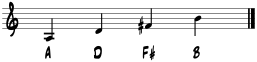
Low 'A', D Tuning - For Soprano, Concert and Tenor ukulele. The same as the higher four strings of a standard tuned guitar with a capo at the seventh fret.
For setting up music notation programs like Finale and Sibelius this tuning is:
MIDI: A = A4, D = D4, F# = F#4, A = B4
C4 is middle C.
Alternate Tunings
Here are the tuning recommendations of several prominent ukulele musicians.
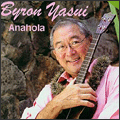
Byron Yasui's Recommended Ukulele Tunings:
  • Soprano - A D F# B
  • Concert (Alto) - G C E A
  • Tenor - F Bb D G
  • Baritone - Eb Ab C F

For more information on Byron YasuiByron Yasui's LearningUkulele.com Musician Listing .

Joel Eckhaus's Recommended Ukulele Tunings:
  • Soprano - A D F# B
  • Concert (Alto) - G C E A
  • Tenor - E A C# F#
  • Baritone - D G B E

For more information on Joel EckhausJoel Eckhaus's LearningUkulele.com Musician Listing .

James Hill's BEBE Baritone Tuning::
  • Baritone - B E B E

James has been using this tuning for awhile. It's a great Drone like tuning.

For more information on James HillJames Hill's LearningUkulele.com Musician Listing .

Other Instrument's Tunings
Tune the Ukulele Like Other Instruments
Banjo Tuning

Tune string one down a whole step and you have a Banjo like tuning.

Mandolin Tuning

NOTEAny Tuning Is Possible on a ukulele as long as the ukulele's construction supports it and a string is available. The support part is the combined string tension on the ukulele's construction. All strings manufactures have the individual string tensions available. Remember the the strings length, the scale length of the instruments the tensions as well as the tuning.