Learning Ukulele with Curt

All 971 Lessons

With over 900+ lessons on LearningUkulele.com & Learning Ukulele with Curt, it can be a bit of an overwhelming task to navigate and find what you're looking for. The LessonSERIES section is a good place to start, as it presents a structured approach and curated list of lessons on a specific area of study.
Louis-Martin/Curt-2020-FFUF

29 August 2026

Access:

Showing 801–820 of 971 results

UL48b

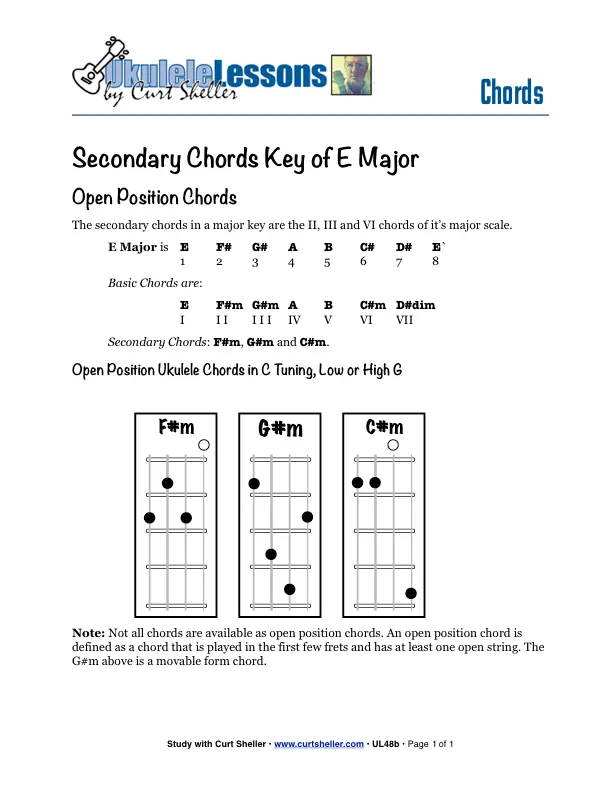
Secondary Chords - E Major

The secondary chords for any major key are the II, III and VI chords of its corresponding major scale. For E Major the secondary chords are: F#m, G#m and C#m. From the primary and secondary chords of a major key, countless songs and chords progressions can be played.

UL54b

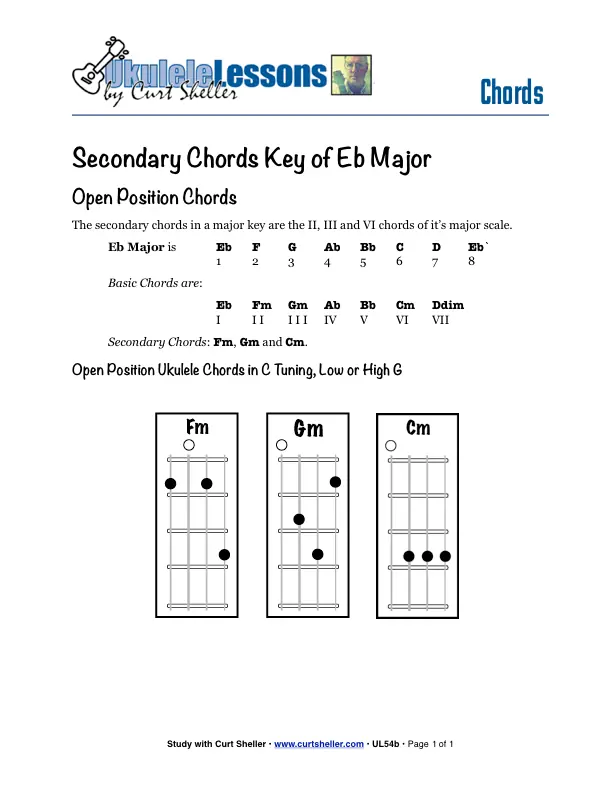
Secondary Chords - Eb Major

The secondary chords for any major key are the II, III and VI chords of it’s corresponding major scale. For Eb Major, the secondary chords are: Fm, Gm and Cm. From the primary and secondary chords of a major key, countless songs and chords progressions can be played.

UL52b

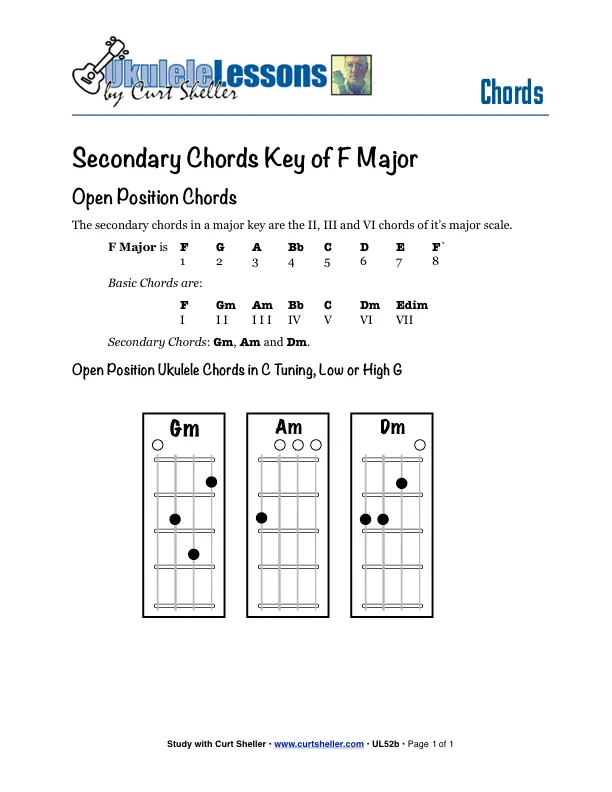
Secondary Chords - F Major

The secondary chords for any major key are the II, III and VI chords of it's corresponding major scale. For F Major, the secondary chords are: Gm, Am and Dm. From the primary and secondary chords of a major key, countless songs and chords progressions can be played.

UL50b

Secondary Chords - F# Major

The secondary chords for any major key are the II, III and VI chords of it's corresponding major scale. For F# Major, the secondary chords are: G#m, A#m and D#m. From the primary and secondary chords of a major key, countless songs and chords progressions can be played.

UL45b

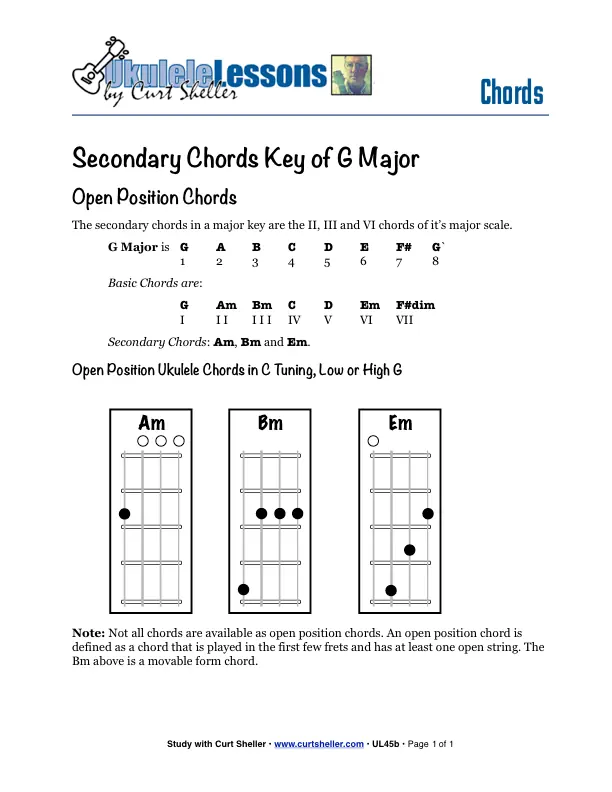
Secondary Chords - G Major

The secondary chords for any major key are the II, III and VI chords of it’s corresponding major scale. For G Major the secondary chords are: Am, Bm and Em. From the primary and secondary chords of a major key countless songs and chords progressions can be played.

UL57b

Secondary Chords - Gb Major

The secondary chords for any major key are the II, III and VI chords of it's corresponding major scale. For Gb Major, the secondary chords are: Abm, Abm and Ebm. From the primary and secondary chords of a major key, countless songs and chords progressions can be played.

ULSD01

Secondary Dominant V of ...

A "Secondary Dominant" chord is defined as any seventh chord built on a scale root that is diatonic to the key that resolves up a perfect fourth or down a perfect fifth to a full diatonic chord. These chords function as a dominant (V) chord to the next chord, serving to temporarily tonicize the following chord.

UL128

Selecting a `Ukulele

A `Ukulele is: Light Weight, Affordable and Portable | Four Strings and Four Fingers | Less Need for Strumming Accuracy | There is nott a lot expected from a ukulele player. The 'Ukulele (pronounced oo-koo-lele) comes in four standard sizes: Soprano (sometimes called Standard), Concert, Tenor and Baritone.


ULHA-YB-206

She Loves You

Harmonic Analysis (RMA) Worksheet for the song: "She Loves You".

UL126-UKESTRUM1-Shuffle

Shuffle Strum

The Shuffle Strum has applications in Blues, Jazz, and Country.

ULHA-YB-308b

Silent Night

Harmonic Analysis (RMA) Worksheet for the song: "Silent Night".

UL59e

Simple - Basic Chord Progression

Diatonic scales such as the major and minor scales lend themselves particularly well to the construction of common chords because they contain a large number of perfect fifths. Such scales predominate in those regions where harmony is an essential part of music, as, for example, in the common practice period of western classical music.

UL128-Capo

Simulating Various Ukulele Scale Lengths

If you don't have any concert size instruments nearby to try in a store you can create the scale length on your tenor with an inexpensive capo. A capo on the second or third frets of a tenor leaves you with a scale length (and fret spacing) similar to a concert and the neck width at that level should be very close to that found on most concerts. And if you want to get an idea of what a soprano scale would feel like put the capo at the 4th fret and you'll be almost exactly at the standard 13 5/8 inch length. However the width at that point on a tenor will in most cases be greater than at the nut of a soprano.
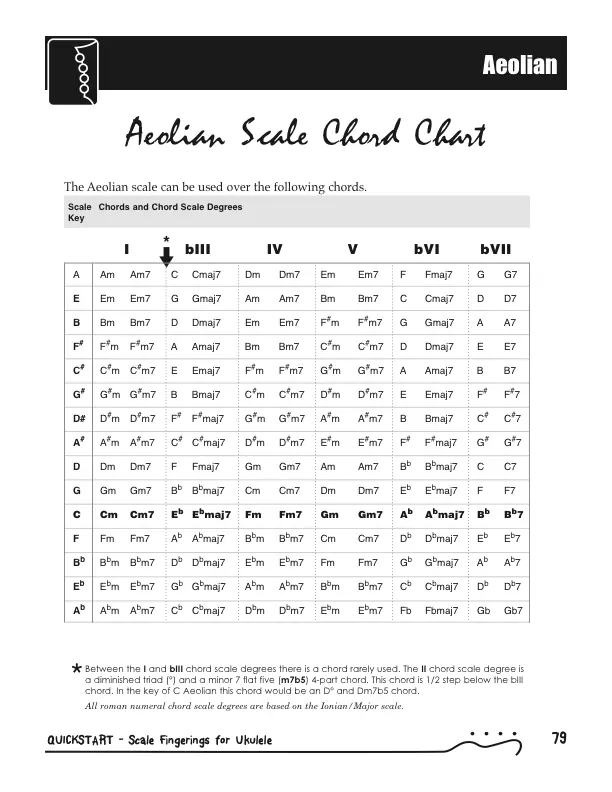
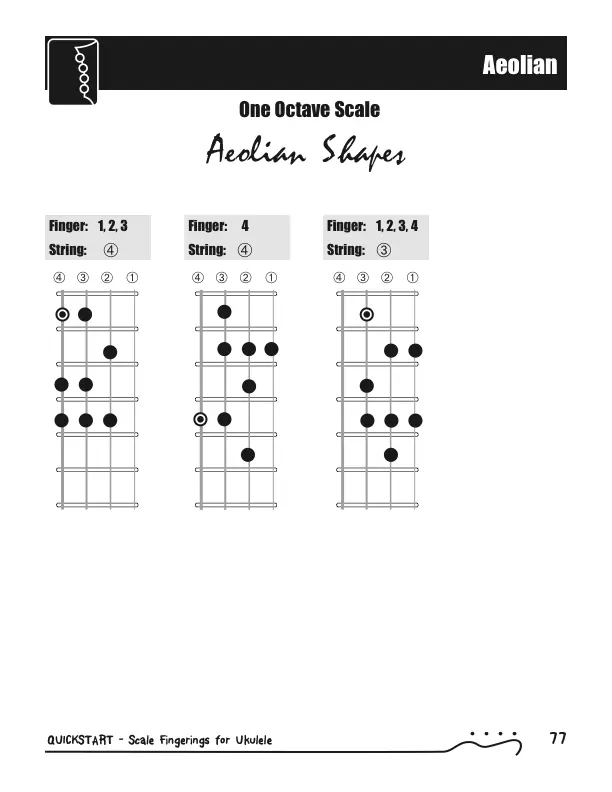
UL04-QS-AEOLc

Six Essential Scales - Aeolian/Natural Minor Chords

The Aeolian/Natural Minor scale is one of the six essential scales that every ukulele player should know. The scale formula, based on the major scale is: 1 2 b3 5 b6 b7 8.

UL04-QS-AEOLs

Six Essential Scales - Aeolian/Natural Minor QuickStart Scale Shapes

QuickStart scale shapes summary for "Aeolian/Natural Minor", one of the six essential scales that every ukulele player should know. The scale formula for this scale, based on the major scale is: 1 2 b3 4 5 b6 b7 8´.

UL04-QS-BLUESc

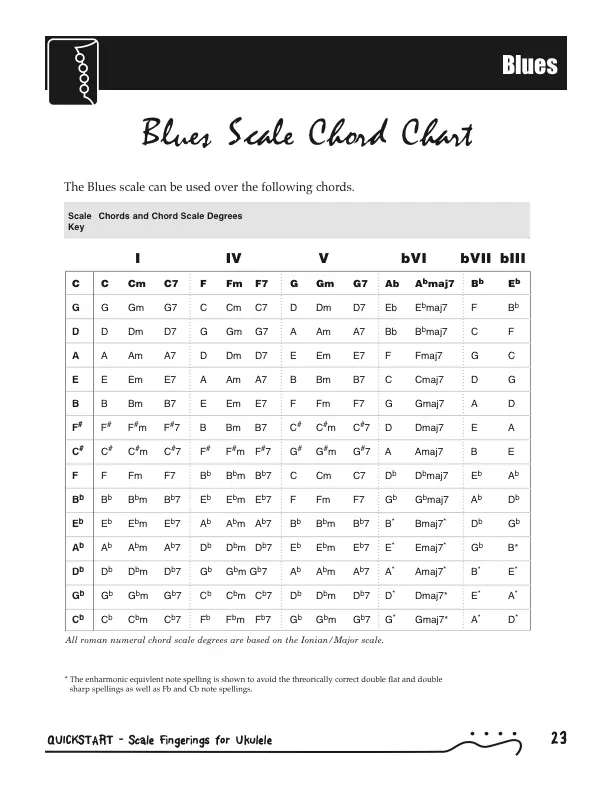
Six Essential Scales - Blues/Minor Pentatonic Chords

The Blues/MInor Pentatonic scale is one of the six essential scales that every ukulele player should know. Here are the chords for all 15 Pentatonic/Major Pentatonic scales.

UL04-QS-BLUESs

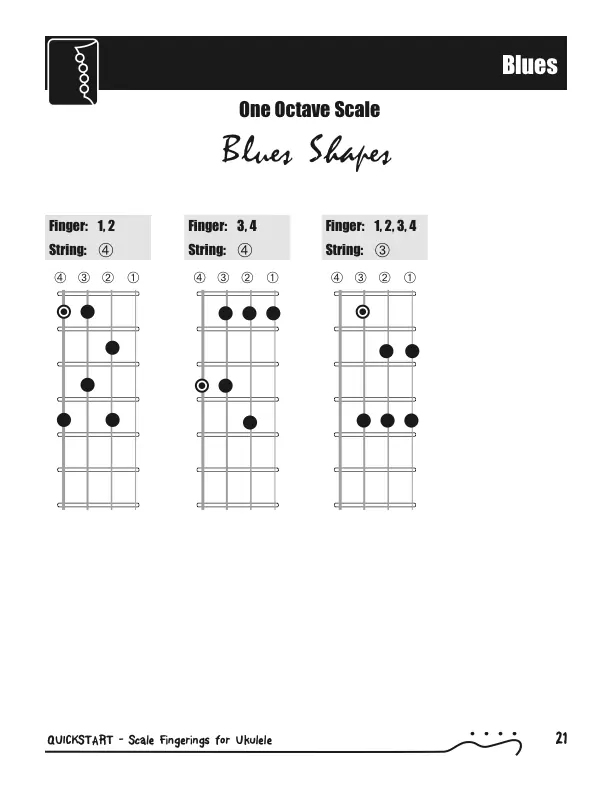
Six Essential Scales - Blues/Minor Pentatonic QuickStart Scale Shapes

QuickStart scale shapes summary for Blues/Minor Pentatonic, one of the six essential scales that every ukulele player should know.

UL04-QS-DORc

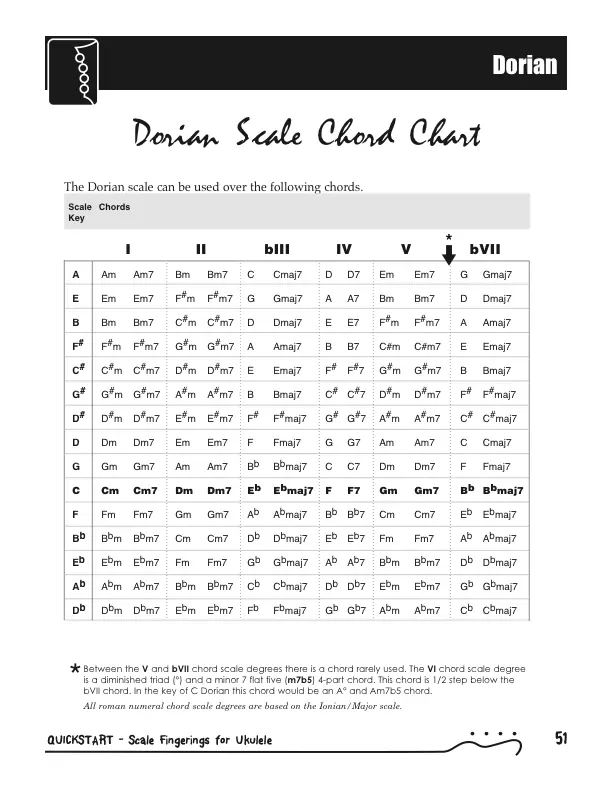
Six Essential Scales - Dorian/Minor Chords

The Dorian/Minor scale is one of the six essential scales that every ukulele player should know. The scale formula, based on the major scale is: 1 2 b3 5 6 b7 8.

UL04-QS-DORs

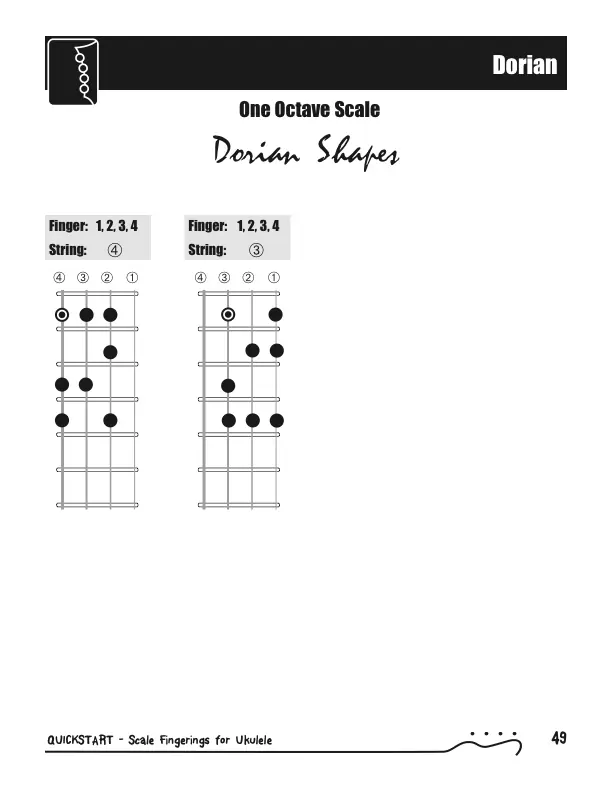
Six Essential Scales - Dorian/Minor QuickStart Scale Shapes

QuickStart scale shapes summary for Dorian/Minor, one of the six essential scales that every ukulele player should know.

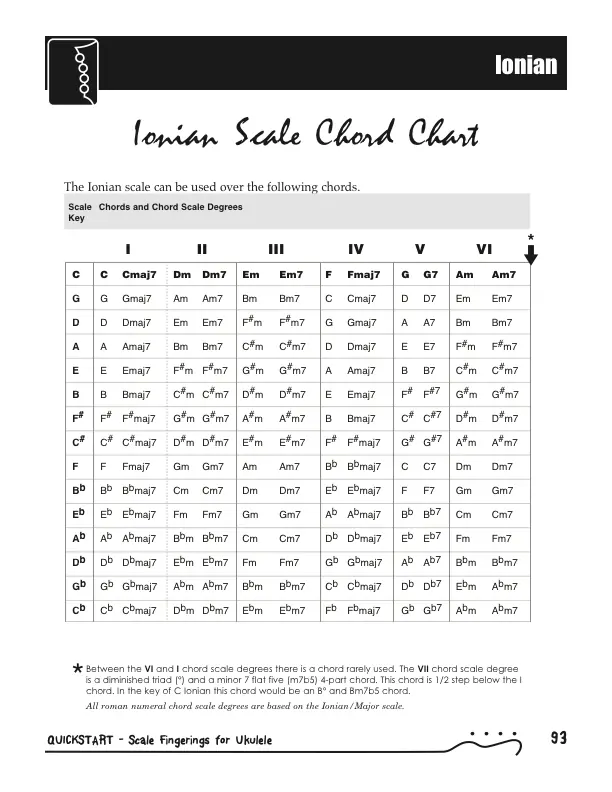
UL04-QS-IONc

Six Essential Scales - Ionian/Major Chords

The Ionian/Major scale is one of the six essential scales that every ukulele player should know. Here are the chords for all 15 Ionian/Major scales. From the Ionian/Major scale all other diatonic and pentatonic scales can be derived.

Non-Searchable, NO-frills, Long List of All Available Lessons