
Published:
Updated:
Learning Ukulele with Curt
Star Spangled Banner
The Star-Spangled Banner is the national anthem of the United States of America. The lyrics come from a poem written in 1814 by Francis Scott Key, a then 35-year-old amateur poet who wrote Defence of Fort McHenry after seeing the bombardment of Fort McHenry at Baltimore, Maryland, by Royal Navy ships in Chesapeake Bay during the War of 1812.
Author(s): Publisher: Code: UL422
Main Category: Accessories Main Instrument: Any

2026-08-19
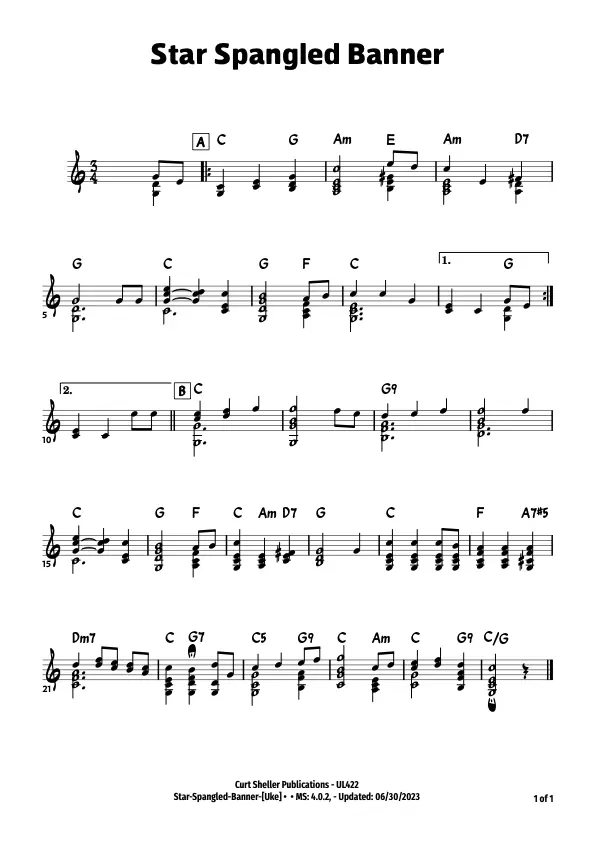
If you're a registered site member and have the correct permissions you can view ALL the pages of this PDF or Samples pages at a larger size using the LearningUkulele.com Online PDF Viewer.
Download PDFThis Download IS part of your Gold Site Access and a FREE download. Thanks for supporting the site. – Curt
Each PDF file is a professionally prepared, formatted, high resolution file that prints out great. You'll need a PDF Reader or application capable of viewing PDF files to view the PDF.
NOTE: Download the current PDF file for the latest, complete, and most up-to-date version. As well as additional information not presented on-line.
The Star-Spangled Banner is the national anthem of the United States of America. The lyrics come from a poem written in 1814 by Francis Scott Key, a then 35-year-old amateur poet who wrote Defence of Fort McHenry after seeing the bombardment of Fort McHenry at Baltimore, Maryland, by Royal Navy ships in Chesapeake Bay during the War of 1812.
The lyrics come from a poem written in 1814 by Francis Scott Key , a then 35-year-old amateur poet who wrote Defence of Fort McHenry after seeing the bombardment of Fort McHenry at Baltimore, Maryland, by Royal Navy ships in Chesapeake Bay during the War of 1812.
On September 3, 1814, following the Burning of Washington and the Raid on Alexandria, Francis Scott Key and John Stuart Skinner set sail from Baltimore aboard the ship HMS Minden, flying a flag of truce on a mission approved by President James Madison. Their objective was to secure the exchange of prisoners, one of whom was Dr. William Beanes, the elderly and popular town physician of Upper Marlboro and a friend of Key's who had been captured in his home. Beanes was accused of aiding the arrest of British soldiers. Key and Skinner boarded the British flagship HMS Tonnant on September 7 and spoke with Major General Robert Ross and Vice Admiral Alexander Cochrane over dinner while the two officers discussed war plans. At first, Ross and Cochrane refused to release Beanes, but relented after Key and Skinner showed them letters written by wounded British prisoners praising Beanes and other Americans for their kind treatment.
Star Spangled Banner is in the The Daily Ukulele — 365 Songs for Better Living book.
Strum a different song every day with easy arrangements of 365 of your favorite songs in one big songbook! The Daily Ukulele features ukulele arrangements with melody, lyrics and uke chord grids and are in ukulele-friendly keys that are particularly suited for groups of one to one hundred to play and sing.