

Red River Valley is a folk song and cowboy music standard of controversial origins that has gone by different names—e.g., "Cowboy Love Song", "Bright Sherman Valley", "Bright Laurel Valley", "In the Bright Mohawk Valley", and "Bright Little Valley" — depending on where it has been sung.
Subjects(s): Beginner • Repertoire


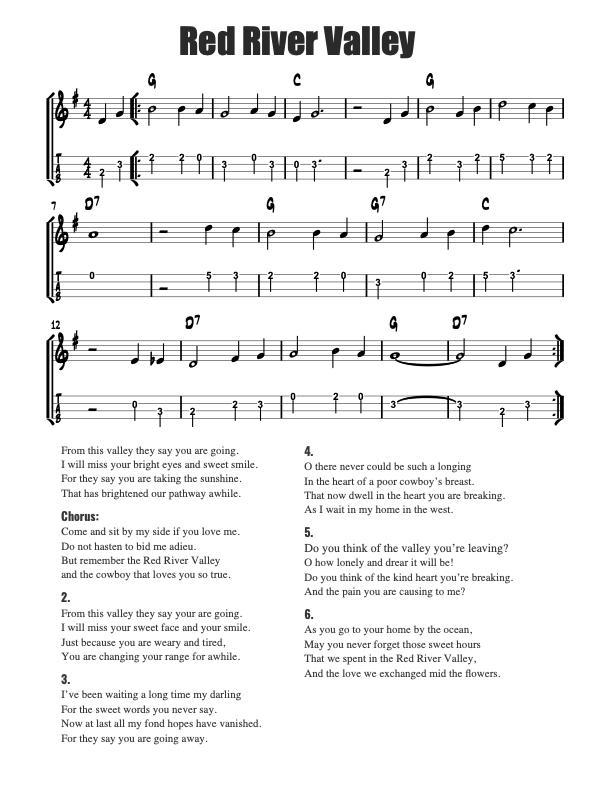
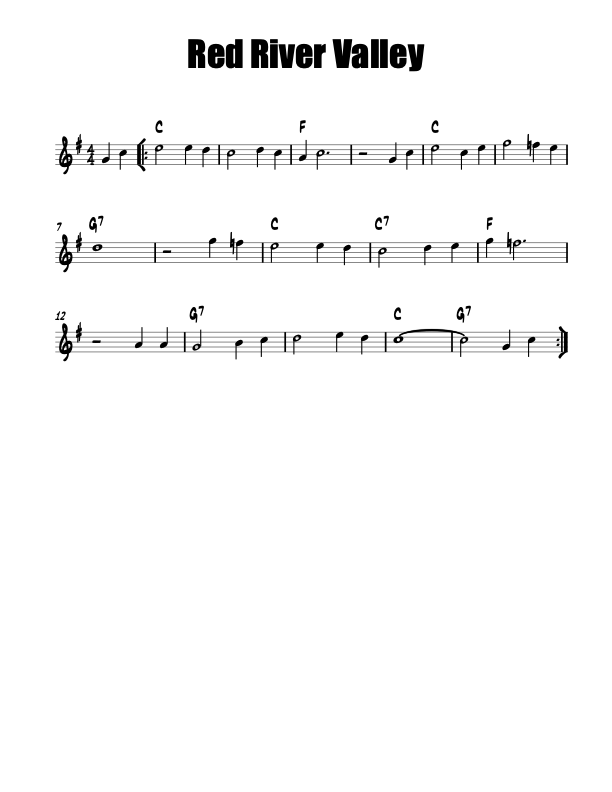
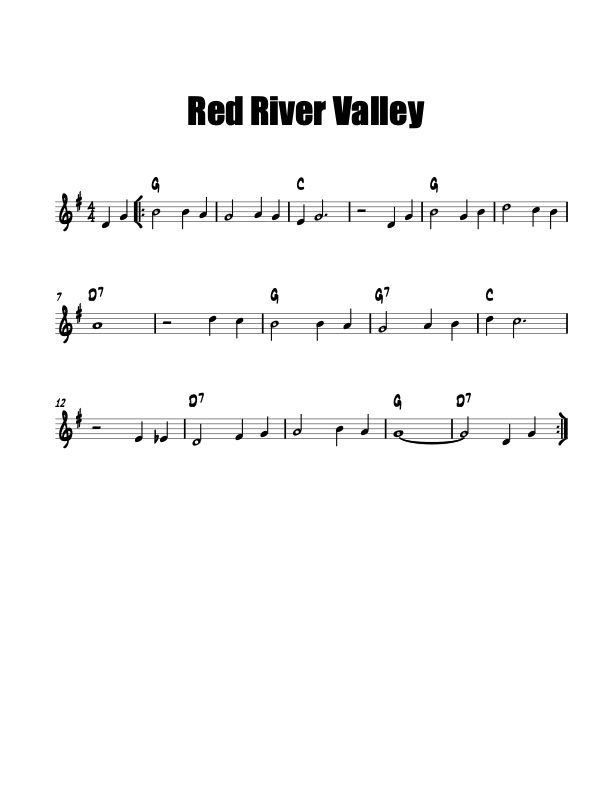
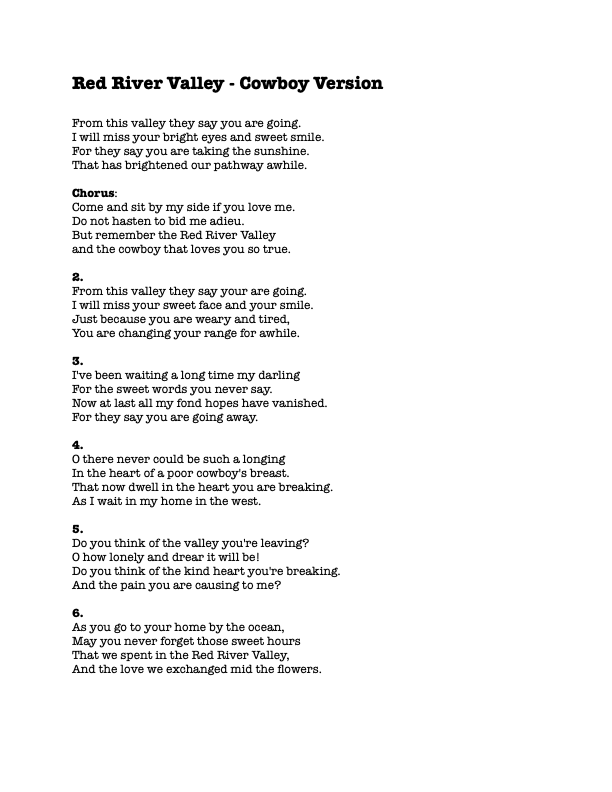
Red River Valley is a folk song and cowboy music standard of controversial origins that has gone by different names—e.g., "Cowboy Love Song", "Bright Sherman Valley", "Bright Laurel Valley", "In the Bright Mohawk Valley", and "Bright Little Valley" — depending on where it has been sung.

- Common Keys: C, G • Really any common Folk key (C G D A E).
- First Melodic Interval: P5 ↑ P4 • ( starts on the perfect fifth of the key and the next melody note is up a perfect fourth. In the key of G major this would be: D to G)
G, C Tuning Notes
Note Inventory: This is simply knowing what the notes of the melody are, and where can you play them on your instrument? In our case, the ukulele. In C Tuning the notes are, from the lowest note D to the highest note D, one octave higher: D Eb E F A G C D'. These can all be played in the open position. Only the high D is slightly our of position on string one, fret (5). The Eb is a common chromatic substitution leading to the D7 on line three.
The E G and A can all be played in alternate note locations.
- A is available on string four fret (2) and string one open
- E is available on string for two and string three fret (4)
- G is available on string four open and string two fret (3)




Island Strum

Island Strum.
(D = Down, U = Up)

There is anecdotal evidence that the song was known in at least five Canadian provinces before 1896.[2] This finding led to speculation that the song was composed at the time of the 1870 Wolseley Expedition to Manitoba's northern Red River Valley. It expresses the sorrow of a local woman (possibly a Métis) as her soldier lover prepares to return to the east.


The Lion Sleeps Tonight, also known as "Wimoweh", "Wimba Way" or "Awimbawe", is a song written and recorded originally by Solomon Linda with the Evening Birds for the South African Gallo Record Company in 1939, under the title "Mbube". Composed in Zulu, it was adapted and covered internationally by many 1950s pop and folk revival artists, including Pete Seeger, the Weavers, Jimmy Dorsey, Yma Sumac, Miriam Makeba and the Kingston Trio.

Strum a different song every day with easy arrangements of 365 of your favorite songs in one big songbook! The Daily Ukulele features ukulele arrangements with melody, lyrics and uke chord grids and are in ukulele-friendly keys that are particularly suited for groups of one to one hundred to play and sing.


return in your investment)—it is this— learning the
f*ckingnotes of your OWN instrument. Sorry for the tough talks—but it is sooooo true!